
Like the MFM podcast this site is not about big facts and truths so somethings may be incorrect.
February 1, 2016
3 – Our Favorite Thrider
In this episode, Georgia and Karen discuss the Cameron Todd Willingham arson case, the Oakland County child killings and comedian/We Watch Wrestling podcast co-host Tom Sibley shares his hometown upholstery murder story.
Race You To Georgia's Place!
Turns out it's a completly bunk science

Hair microscopy is an inexact science. Its reputation has become seriously disgraced as it was found out that the microscopic hair comparison unit of the FBI perjured a massive Amount of testimony. Microscopic hair analysis is still acknowledged as a useful technique for confirming hairs do NOT match, but the ability of the field to identify a specific person's hair has fallen into disrepute. The Justice Department and the FBI formally acknowledged that during more than a two-decade period leading up to the year 2000, nearly every examiner in an elite FBI forensic unit gave flawed testimony in almost all trials in which they gave evidence against criminal defendants. They released findings on 268 re-examined trials in which hair analysis was used. The review concluded that in 257 of these cases analysts within the FBI Lab’s microscopic hair comparison unit had overstated the accuracy of the findings in favor of the prosecution. That is more than 95% of the cases reviewed so far. The review is still in progress, with about 1200 cases still to be examined.

Forensic analysis of DNA from hair samples is commonly used for identification, however, it is in many ways the most overestimated and misrepresented DNA sample.

Michael Malone now lives in Richmond, VA working on carpentry projects and his golf game.
In the early 1990's reports started to come in about the sloppy work by examiners at the FBI lab, they were producing unreliable forensic evidence in court trials. By 1994 the Justice Department created a task force to investigate (they would eventually review 6,000 cases by 2004). Even though they knew the entire hair and fiber analysis lab had weaknesses, they chose to concentrate solely on one examiner who was FBI Special Agent Michael P. Malone. The inquiry took nine years, ending in 2004, but the findings were never made public as was Agent Malone being discredited as an expert in 1997. As a result of limiting the search in this way, it’s considered that hundreds of defendants nationwide remain in prison or on parole. In April 2012, Justice Department officials announced that they had known for years about flawed forensic work. Which means that potentially innocent people had been convicted based on this work, along with flawed testimony given in some trials. To add further insult to injury, prosecutors failed to notify defendants attorneys that this was even going on. This includes the cases where the forensics were troublesome to begin with.
Victims Of This Flawed Science
Donald E. Gates who had served 27 years was exonerated. Malone is held directly accountable for this. Donald Gates was convicted in 1982 for the rape and murder of a Georgetown University student. In Gates’ case, Michael Malone was the key testifier to the forensic evidence. He stated that Donald Gates’ hairs were “microscopically indistinguishable” from hairs found on the victim’s body…and that in twelve years of examining hairs for the FBI, there were only two occasions out of ten thousand where the hairs from two people could not be distinguished. This clearly implied that the hair from the crime scene belonged to Donald Gates. The jury convicted him and Donald was sentenced to 20 years to life in prison.

Donald Eugene Gates
In January 2002, the Justice Department finally sent a letter to the prosecutors in Gates’ case, informing them that Malone’s lab report was not supported by his notes, and advised them to determine if it was Malone’s hair testimony that was key to the conviction. Unfortunately the prosecutors failed to tell anyone so none of Donald Gates’ defense team were notified.
Donald Gates was left in prison for many years past when they knew Michael Malone had given flawed testimony. Donald always maintained his innocence, and in 2007 Gates requested another DNA test to be conducted. In 2009 the DNA test absolutely eliminated Donald Gates as the killer and rapist, and he was exonerated.

Santae Tribble
In 1980, Santae Tribble was convicted of the armed robbery and murder of John McCormick, who had been attacked and killed by a stocking-masked assailant. Shortly after the crime, a canine officer and his dog recovered the stocking used as the mask near the scene of the crime. At the trial, an FBI analyst testified that he had “matched in all microscopic characteristics” Santae Tribble’s hair to one of thirteen found in the stocking. Santae actually had three witnesses who could give him an alibi during the time the crime was committed, but because the prosecutor really emphasized the DNA hair evidence saying, "There is one chance in 10 million that it could be someone else's hair” the jury found him guilty, and Santae Tribble was given 20 years to life. He was later paroled in 2003.
In 2012, Santae’s attorneys successfully obtained mitochondrial DNA testing on the thirteen hairs recovered from the stocking mask. The analysis, conducted by a private lab, revealed FBI analysts’ errors and none of the hairs shared Tribble’s genetic profile. Even more so upsetting is one had actually come from a dog. Tribble was exonerated in December 2012 even though he had already served his full prison sentence for this heinous crime he did not commit.
That's like every Forensic Files, their whole show is based on this bunk science

Forensic Files was an American TV series that features true crime and medical cases that were solved using forensic science. It ran from 1996 to 2011. The TV series goes into the details of the different scientific methods used in each case, presenting interviews from investigators, and actual crime scene photos and videos. A version of the series was broadcast on the British Channel Five, under the name Murder Detectives and on Lifetime as Medical Detectives.
The show helped pioneer documentary style crime-science shows. It takes a "whodunit" approach, making each case a mystery to be solved. Every half-hour episode follows one case from initial investigation until conviction, acquittal, or some other legal resolution. Forensic File's official website says it profiles "puzzling, often baffling cases whose riddles are ultimately solved by forensic detection." The cases and people are real. Pathologists, medical examiners, police officers, detectives, prosecutors, defense attorneys, friends and families of victims or suspects (if cooperation is given) are all interviewed about their roles.
Surprisingly DNA testing is rarely focused on. While ballistics, hair analysis, and fingerprint comparisons do turn up, the show seems to prefer unusual evidence such as animal hairs, plant analysis, or arson investigation. Scientists and forensic experts in many fields are interviewed.Not every case is a crime. In some cases, the investigation reveals that suspects are innocent, and the death was an accident or suicide. Several shows have profiled people who have been jailed for or convicted of a crime, and who were ultimately exonerated by forensic evidence.
Watch Forensics File On Youtube:
This guy was super suspicious because he had all those "Do you want to be a star?" flyers posted everywhere and his own recording studio...which is textbook pedophilic entrapment stuff, or also a way to get a young star on the rise...

Over the two-year period between 1979 and 1981 at least 28 African-American children,
adolescents, and adults were killed. Wayne Williams, an Atlanta native who was 23 years old at the time of the last murder, was arrested for and convicted of two of the adult murders, and sentenced to two consecutive life terms. Police subsequently have attributed a number of the child murders to Williams and closed the cases, although he has not been tried or convicted in any of those cases.
Wayne Williams
On May 22, 1981, detectives got their first major break when an officer heard a splash beneath the Jackson Parkway Bridge during a stakeout for the Atlanta Child Killer. Another officer saw a white 1970 Chevrolet station wagon turn around and drive back across the bridge. Two police cars stopped the suspect station wagon about a half mile from the bridge. The driver was Wayne Bertram Williams, a supposed music promoter and freelance photographer. Dog hair and fibers recovered from the rear of the vehicle were later used as evidence in the case against Williams, as similar fibers were found on some of the victims. They were found to match his dog and the carpet in his parents' house. Two days later, on May 24, the nude body of Nathaniel Cater, 27, was found floating downriver a few miles from the bridge where police had seen the suspicious station wagon. Based on this evidence, including the police officer's hearing of the splash, police believed that Williams had killed Cater and disposed of his body while the police were nearby.
Much circumstantial evidence led the police to consider Williams as the prime suspect. First, he was the only person stopped during the month-long stakeout of twelve bridges, and Williams had stopped on the bridge immediately after the splash was heard. Second, police noted that Williams' appearance resembled a composite sketch of the suspect, including a bushy Afro sticking out from the sides of a baseball cap, and a birthmark or scar on the left cheek. Investigators who stopped Williams on the bridge also noticed a 24-inch nylon cord in his vehicle. This cord seemed to match the choke marks on Cater and other victims. Additionally, Williams admitted to spending much of his time seeking out and auditioning African-American boys with flyers whose ages matched many of the victims. He was asked to take an FBI-administered polygraph examination in which he subsequently failed.

1982 Jurors in the Wayne Williams trial leave a bus to walk the Jackson Parkway Bridge to examine the site where the prosecution said Williams dumped his victims into the Chattahoochee River

One of Wayne Williams flyers used to attract young men to him
There were also fibers from the Williams residence (carpet, automobiles, and pet dog) that were later matched to fibers discovered on many of the victims. Furthermore, the witness Robert Henry claimed to have seen Williams holding hands and walking with one of the victims on the night that victim was believed to have died.
On June 21, 1981, Williams was arrested. A Grand Jury indicted him for first-degree murder in the deaths of Nathaniel Cater and Jimmy Ray Payne. The trial officially began on January 6, 1982. The most important evidence against Williams was the fiber analysis between the victims Williams was indicted for, Jimmy Ray Payne and Nathaniel Cater, and the 12 pattern-murder cases in which circumstantial evidence culminated in numerous links among the crimes. This included witnesses testifying to seeing Williams with the victims, and some witnesses suggesting that he had solicited sexual favors. The prosecution's presentation of fiber statistics, particularly in the testimony of FBI special agent Deadman and in the summing up, has been criticized for being based on speculative assumptions and misleading phrasing of probabilities, to an extent that in some jurisdictions might have resulted in a mistrial. On February 27, 1982 after eleven hours of deliberation, the jury found Wayne Bertram Williams guilty of the two murders. He was sentenced to two consecutive life terms.

Wayne Williams in handcuffs
On May 6, 2005, the DeKalb County, Georgia, Police Chief Louis Graham ordered the reopening of the murder cases of five boys who were killed in DeKalb County between February and May 1981 that had been attributed to Williams. Police Chief Graham believed that Williams may have been innocent of these and other murders. The criminal profiler John E. Douglas said that, while he believes that Williams committed many of the murders, he does not think that he committed them all. Douglas added that he believes that law enforcement authorities have some idea of who the other killers are, cryptically hinting at the Klu Klux Klan by adding, "It isn't a single offender and the truth isn't pleasant."
On January 29, 2007, attorneys for the State of Georgia agreed to allow DNA testing of the dog hair that was used to help convict Williams. This decision was a response to a legal filing as a part of Williams' efforts to appeal his conviction and life sentences. On June 26, 2007, the DNA test results were published, but they failed to exonerate Williams. In fact, the results were that the hairs on the bodies contained the same mitochondrial DNA sequence as Williams' dog, and that the DNA sequence occurs in only about 1 out of 100 dogs. Director of the UC Davis laboratory that carried out the testing, told The Associated Press that while the results were “fairly significant,” they "don't conclusively point to Williams' dog as the source of the hair", because the lab was able to test only for mitochondrial DNA which, unlike nuclear DNA, cannot be shown to be unique to one dog.

Wayne Williams, dressed in prison whites, looks on as attorney Bobby Lee Cook stands to argue his case during a 1986 retrial hearing


Through the years, Wayne Williams has maintained his innocence
1981 Atlanta Mayor Maynard Jackson poses with the reward money for the capture of the murderer
Later in 2007, the FBI performed DNA tests on two human hairs found on one of the victims. The mitochondrial DNA sequence in the hairs would eliminate 99.5% of persons by not matching their DNA. The mitochondrial DNA sequence in the hairs would eliminate 98% of African American persons by not matching their DNA. However, they matched Williams' DNA and so did not eliminate the possibility that the hairs were his.

Handwriting analysis is one of the more “forensic-sounding” methods of police work that most people associate with shows like CSI. In reality, it is not a totally infallible and exact science. While an expert analyst can detect many instances of forgery, a good simulation can be undetectable. That doesn’t mean that it should be discredited, however. First, let’s make sure of what it is NOT – forensic handwriting analysis does not delve into any social or psychological profiles of a person.
Meaning, the shape of your g’s and length of your j’s as you write them don't supposedly hold the answers to your sexual drive and most fitting career. This falls under the realm of Graphology, and has nothing to do with how handwriting analysis actually benefits police work. What forensic handwriting analysis DOES do, is study and compare the way people form letters and string them together. Part of that is learning how a person’s individual writing style could affect their handwriting to make it truly unique.


There is some dispute regarding whether handwriting analysis is sufficiently reliable to be admissible in court. However, most courts agree that the field of forensic document examination is premised on the assumption that no two persons' handwriting is exactly alike. The field assumes that each person has a unique handwriting pattern that allows the person to be identified through a comparison of proper handwriting specimens. Analysts subjectively assess the qualities and quantities of characteristics such as pen lifts, shading, pressure and letter forms. All acknowledge that this is not an exact science and that different experts can reach different conclusions. Many courts have recognized the American Board of Forensic Document Examiners as an appropriate accrediting organization for handwriting experts. This organization has been held to have a legitimate certification process and verifiable professional standards. There are other organizations that purport to certify experts in this field, but some are simply mail order businesses that sell certificates. Other organizations have their roots in graphology, which is the "art" of determining personality traits from looking at a person's handwriting.
One of the most recent, high-profile cases to use handwriting analysis would be the case against Robert Durst for his killing of Susan Berman in December of 2000. The lead forensic analysts on the case were assigned to study the handwriting of both a letter Durst wrote to Berman the previous year, and the anonymous note sent to police warning them of finding “a cadaver” at the late Berman’s house. What they did was use several “points of comparison” to match the two pieces of evidence – things like the small curve that was present at the end of the Ls and the top cross bar in the Es being longer than the bottom. This is believed to have helped solidify the case against Robert Durst.


You can't call it scientific evidence because it's not science it's kinda like conjector and magic talk
There is reasonable doubt blood splatter evidence may not be as scientifically correct as prosecutors have exclaimed. Bloodstain pattern analysis or BPA has strong scientific foundations and can be helpful to tell the story behind a violent crime. The problem with BPA or what causes the waiver in reliability comes from the analyst and their credentials, training and whether or not bias is a factor in the investigation. There has been many times when reputable analysts disagree on findings due to cognitive bias.

Duane Deaver said the blood splatter proved murder during the Micheal Peterson Trial and was later fired for mishandling evidence
The JDI Center for the Forensic Sciences at University College London spoke about there research on “cognitive forensics” and how cognitive biases affect forensic scientists. For example, the hindsight bias can lead one to work backward from a suspect to the evidence, and then the confirmation bias can direct one to find additional confirming evidence for that suspect even if none exists. They discussed studies that show “that the same expert examiner, evaluating the same prints but within different contexts, may reach different and contradictory decisions.”’

As well as cognitive bias clouding the judgement of BPA analysts there is also the fact there is no standardization across the practice. Sometimes the effects of gravity aren’t considered. Surface tension and air drag need to be a factor to determine greater accuracy of the force and velocity of inflicted wounds. Forensic investigators look at the size of blood spots created on surfaces at the crime scenes to get an idea of the volume and velocity of blood drops produced by a wound. But this doesn't always provide a clear picture.
Paid by the defense in the Peterson trial, Dr. Henry Lee concludes there was too much blood for an accidental fall down the stairs, a beating, or even a murder.
"Often, the same pattern can be produced in many ways," said Daniel Attinger, an expert in fluid dynamics at Columbia University in New York who is working with the Department of Justice to strengthen the scientific framework behind blood pattern analysis. One limitation of this technique, though, is that a spot of blood must be well-preserved to maintain the accuracy of this science. The type of surface also depends on how long the crime science can be kept preserved. If indoors there is obviously a greater chance of preservation but only wood and drywall preserve the shape of blood drops whereas glass and tile are too smooth and interfere. If outdoors there is less preservation making BPA mostly unreliable.
Experts have often disagreed on what each blood splatter means during trials. During the Staircase Murder trial there was a great deal of opinions when it came to the blood splatter evidence. Along with pools of blood on the floor and lower steps, defense expert, Dr. Henry Lee testified his client's hallway also contained an astounding amount of blood spatter, estimating there were 10,000 blood drops. Lee told Michael's jury the scene was so bloody, it was beyond what he would expect to find even after a brutal beating. The scientist's traumatic words had a blunt force: "Too much blood for a beating." Of course, if there was too much blood for a murder, there was surely too much blood for an accident. When Dr. Lee was asked what event would result in a scene bloodier than that of a beating, he shrugged and said it was a mystery. The mysterious incident becomes clear when the crime scene evidence is viewed as a whole. In Lee's word's "You have to look at the totality."


Micheal Peterson's shoe print on the back of Kathleen's pants
Bearing in mind the blood-soaked soles of Kathleen Peterson's feet, the blood spatter found up inside the leg of Michael Peterson's shorts which suggests he was standing over Kathleen Peterson during an impact, Michael's tennis shoe print stamped in blood on the back of Kathleen Peterson's sweatpants, and the wet blood spatter on top of dried spatter, it's not impossible to theorize that after Michael beat his wife and left her to die, she was able to revive herself. She struggled to her feet and probably surprised Michael, who panicked and beat his wife again. Then, most likely realizing there was far too much blood for a clumsy slip down the stairs, Peterson tried to clean away some of the blood with towels. The useless endeavor was eventually abandoned. Time was becoming an issue, but calling 9-1-1 had to be delayed until the scene was arranged. He spent an hour hiding items, preparing fake props, repositioning his wife's corpse, and removing his shoes and socks. Of course this is only one of many theorize based on the blood splatter.

Micheal Peterson during his trial
Micheal Petterson's request for a new trial focuses on testimony provided during the 2003 trial by Duane Deaver, a blood analyst whom the SBI fired in January. Palmbach, who also testified as a defense witness in Peterson's trial, said Deaver's claim that he could pinpoint where blood on the staircase came from is misleading and that the tests he conducted were flawed.
Deaver focused on only some of the blood droplets in the area and didn't disclose to jurors that there was other blood at the scene that didn't fit his findings. Also, many of Deaver's tests appeared to be used to confirm a theory rather than sort through the evidence for the most likely scenario, he said. "One of the real no-nos and dangers in the field is you conduct a test and you stop, leaving behind other data,” he said. An independent review of the SBI crime lab last year found that Deaver was linked to some of the most egregious cases where blood evidence was misstated or falsely reported in about 200 criminal cases between 1987 and 2003. Human error and cognitive bias are two reasons why blood splatter analysis is not considered an exact science.

It's a big case about the innocence project and debunking the arson investigators testimony that ended up being just complete bullshit and wrong

Cameron Todd Willingham
Cameron Todd Willingham was an American man who was convicted and executed for the murder of his three young children by arson at the family home in Corsicana, Texas, on December 23, 1991. Since Cameron Willingham's 2004 execution, significant controversy has arisen over the key arson evidence that was used to convict him. On December 23, 1991, a fire destroyed the Willingham family home. Killed in the fire were Cameron's three daughters: two-year-old Amber Louise Kuykendall and one-year-old twins Karmon Diane Willingham and Kameron Marie Willingham. Cameron Willingham himself escaped the home with only minor burns. Stacy Kuykendall, Willingham's wife and the mother of his three daughters was out shopping for Christmas presents.
Prosecutors charged that Cameron Willingham set the fire and killed the children in an attempt to cover up abuse of the girls. However, there was no evidence of child abuse, and Stacy told prosecutors that he had never abused the children. "Our kids were spoiled rotten", she said, insisting he would never harm their children.
A Stacked Deck
The primary evidence leading to Cameron's arrest and conviction was the result of police inspections after the fire, which determined that the fire had been started using some form of liquid accelerator. This evidence included a finding of char patterns in the floor in the shape of "puddles", a finding of multiple starting points of the fire, and a finding that the fire had burned "fast and hot", all considered to indicate a fire that had been ignited with the help of a liquid accelerator. The investigators also found charring under the aluminum front doorjamb that they believed was further indication of a liquid accelerator, and tested positive for such an accelerator in the area of the front door. No clear motive was found, and Cameron's wife denied that they had fought prior to the night of the fire.

Cameron Willingham with wife Stacy Kuykendall and three daughters: Amber Louise Kuykendall, Karmon Diane Willingham, and Kameron Marie Willingham
In addition to the arson evidence, a jailhouse informant named Johnny Webb was called to testify. The testimony has been criticized as contentious for several reasons. Johnny Webb claimed that Cameron Willingham confessed that he set the fire to hide an injury or death of one of the girls, caused by his wife, although none of the girls were found at the time of death to have physical injuries still distinguishable after the effects of the fire. Webb later told a reporter for The New Yorker that he might have been mistaken and added he was on many medications at that point while being treated for bipolar disorder.

Johnny Webb
At Cameron's trial, Johnny offered an explanation for the individual, distinguishable burns that were found on Amber's forehead and arm, stating that Cameron confessed to burning her twice with a piece of "wadded up" paper in an effort to make it appear as though the children were "playing with fire". Johnny Webb was noted to be unreliable by prosecutor John Jackson, who later advocated to get Johnny Webb released from prison early. Johnny later sent Jackson a Motion to Recant Testimony, which declared, "Mr. Willingham is innocent of all charges." Cameron Willingham's attorneys were not notified and Johnny Webb later recanted his recantation. Johnny Webb later said, "The statute of limitations has run out on perjury, hasn't it?"
Johnny Webb and Jackson consistently denied that Johnny was offered a sentence reduction in return for his testimony against Cameron Willingham. Evidence of such a deal would have eliminated Johnny Webb's testimony. In 2014, Innocence Project investigators said that they had discovered a handwritten note in Webb's files indicating that just such a deal was in play.
Further to the testimony of Johnny Webb and the arson evidence, the prosecution sought to establish that Cameron Willingham's conduct at the time of the fire and in the days afterwards was suspicious. As the fire took hold, Cameron was driven out through the front door of his house, where he crouched down near the entrance. On seeing neighbor Diane Barbee, Cameron began to shout at her to call 911, shouting "My babies are in there!" At trial, his conduct at the scene was described as oscillating between collected and hysterical at times screaming for assistance, and at other times calmly pushing his car back from the flames that were engulfing his house which he did because he claimed he didn't want it to catch fire and add to the fuel of the fire.
At the trial, a prosecutor said that Cameron's tattoo of a skull and serpent fit the profile of a sociopath. Two medical experts confirmed this. A psychologist was asked to interpret Cameron's Iron Maiden poster, and said that a picture of a fist punching through a skull signified violence and death. He added that Cameron's Led Zeppelin poster of a fallen angel was "many times" an indicator of "cultive-type" activities. Psychiatrist James Grigson
said that a man of Camerons's criminal history was an "extremely severe sociopath" and was incurable. James Grigson was then expelled by the American Psychiatric Association and the Texas Society of Psychiatric Physicians for unethical conduct, the APA stating that James Grigson had violated the organization's ethics code by "arriving at a psychiatric diagnosis without first having examined the individuals in question, and for indicating, while testifying in court as an expert witness, that he could predict with 100% certainty that the individuals would engage in future violent acts."

Cameron Willingham with his skull and serpent tattoo showing

Cameron Willingham's Iron Maiden Poster

Led Zeppelin Fallen Angle Poster
At trial, the fire investigator Vasquez testified there were three points of origin for the fire, which indicated that the fire was "intentionally set by human hands". A sample of burned material near the doorway of the house tested positive for mineral spirits, indicating the presence of lighter fluid. Cameron Willingham had escaped the fire with bare feet and no burn marks. This was taken as evidence that accelerator was poured by Cameron as he left the house. Commenting on the condition of the house, Jackson added, "any escape or rescue route from the burning house was blocked by a refrigerator, which had been pushed against the back door, requiring any person attempting escape to run through the conflagration at the front of the house." There were two refrigerators in the Willingham house. Jimmie Hensley, a police detective, and Douglas Fogg, the assistant fire chief (who both investigated the fire) told The New Yorker author Grann that they had never believed that the fridge was part of the arson plot. "It didn't have anything to do with the fire", Fogg said.
Cameron Willingham was charged with murder on January 8, 1992. During his trial in August 1992, he was offered a life term in exchange for a guilty plea, which he turned down
insisting he would not admit to something he had not done, even if it meant sparing his life.
Cameron 's case gained attention in December 2004, when Maurice Possley and Steve Mills of the Chicago Tribune published on poor investigative tactics. Gerald Hurst then examined the arson evidence compiled by state deputy fire marshal Manuel Vasquez. Hurst individually discredited each piece of arson evidence, using publicly supported experiments backed by his re-creation of the elements in question. All twenty of the indications listed by Vasquez of an accelerator being used were rebutted by Hurst, who concluded there was "no evidence of arson" (the same conclusion reached by other fire investigators at that time).
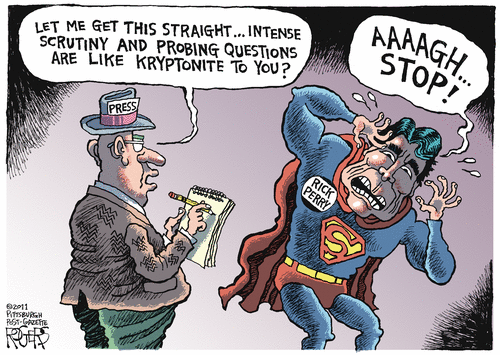
Hurst's report was sent to governor Rick Perry's office, as well as the Board of Pardons and Paroles along with Cameron Willingham's appeal for clemency. Neither responded to Willingham's appeals. "The whole case was based on the purest form of junk science", Hurst later said. "There was no item of evidence that indicated arson". In response to allegations that he allowed the execution of an innocent man, Perry was quoted as stating "he was a wife beater." A spokeswoman for Governor Perry said he had weighed the "totality of the issues that led to Willingham's conviction". The spokeswoman added he was aware of a "claim of a reinterpretation of the arson testimony."
Again in 2009, when an investigative report by David Grann in The New Yorker, drawing upon arson investigation experts and advances in fire science since the 1992 investigation, suggested that the evidence for arson was unconvincing, and, had this information been available at the time of trial, would have provided grounds for Cameron's acquittal. Cameron Willingham maintained his innocence up until his death and spent years trying to appeal his conviction. The Texas Court of Criminal Appeals denied Willingham a writ of habeas corpus a month before his execution.
The State of Texas ordered a re-examination of the case. In August 2009, eighteen years after the fire and five years after Willingham's execution, a report conducted by Dr. Craig Beyler, hired by the Texas Forensic Science Commission to review the case, found that "a finding of arson could not be sustained". Beyler said key testimony from a fire marshal at Willingham's trial was "hardly consistent with a scientific mind-set and is more characteristic of mystics or psychics".


An August 2009 Chicago Tribune investigative article concluded: "Over the past five years, the Willingham case has been reviewed by nine of the nation's top fire scientists — first for the Tribune, then for the Innocence Project, and now for the commission. All concluded that the original investigators relied on outdated theories and folklore to justify the determination of arson. However, this and all else that has since been brought up in the matter has been immediately shot down.
Scott Cobb, right, The Campaign to End the Death Penalty at a protest before a hearing for Cameron Todd Willingham case in 2010 in Austin, Texas
Backdraft

A 1991 American drama thriller film staring Kurt Russell, William Baldwin, Scott Glenn, Jennifer Jason Leigh, Rebecca De Mornay, Donald Sutherland, Robert De Niro, Jason Gedrick and J. T. Walsh. In this movie a rookie firefighter tries to earn the respect of his older brother and other firefighters while taking part in an investigation of a string of arson/murders. This detailed look into the duties and private lives of firemen naturally features widespread pyrotechnics and special effects.
The Innocence Project is a non-profit organization, dedicated to exonerating the wrongfully convicted and advocating for reforms in the criminal justice system to prevent further injustice. The Innocence Project was founded in 1992 by Peter Neufeld and Barry Scheck.

The organization mainly focuses on cases where it’s possible to test or retest DNA evidence, and as of March 2016, the work of the Innocence Project has led to the freeing of 343 wrongfully convicted people based on DNA, including 20 who spent time on death row, and the finding of 147 real perpetrators. One of their more famous cases is that of Steven Avery, whose case is the focus of the Netflix documentary Making A Murder.

The Innocence Project was established in the wake of a landmark study by the United States Department of Justice and the United States Senate, in conjunction with the Benjamin N. Cardozo School of Law, which found that incorrect identification by eyewitnesses was a factor in over 70% of wrongful convictions. The National Registry of Exonerations lists 1,579 convicted defendants who were exonerated through DNA and non-DNA evidence from January 1, 1989 through April 12, 2015. According to a study published in 2014, more than 4% of persons sentenced to death from 1973 to 2004 are probably innocent.
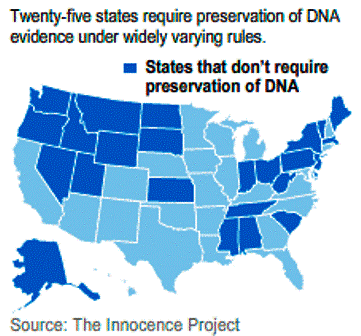
About 3,000 prisoners write to the Innocence Project annually, and at any given time the Innocence Project is evaluating 6,000 to 8,000 potential cases. All potential clients go through an extensive screening process to determine whether or not they are likely to be innocent. If they pass the process, the Innocence Project takes up their case. In roughly half of the cases that the Innocence Project takes on, the clients' guilt is reconfirmed by DNA testing. Of all the cases taken on by the Innocence Project, about 43% of clients were proven innocent, 42% were confirmed guilty, and evidence was inconclusive and not probative in 15% of cases. In about 40% of all DNA exoneration cases, law enforcement officials identified the actual perpetrator based on the same DNA test results that led to an exoneration.

In early 2014, the infotainment program Inside Edition aired a segment about the dangers purportedly posed by 9-volt batteries, focusing on a house fire reportedly touched off when improperly discarded batteries ignited inside a paper bag and started a fire that substantially damaged a family's home. 9-volt batteries are sometimes used to intentionally ignite kindling with relative ease usually in conjunction with steel wool.
Two incidents involving damage to homes due to suspected 9-volt battery fires have been widely reported. A Colorado family's house was said to have caught fire due to 9-volt batteries that jostled inside a paper bag intended to be disposed in the trash.
A New Hampshire family sustained fire damage to their home following the unintentional ignition of 9-volt batteries stored in a junk drawer. The New Hampshire Department of Safety's Fire Division published a warning in August 2012 about 9-volt battery safety in response to the incident, and even before that blaze EHS Safety News America had cautioned that if you are storing loose 9 volt or AA or other batteries in a kitchen drawer or a "junk" drawer in your home, watch how you store them. Above all don't store them loose and rolling around with other metal, glues and more of the lovely mix of things we keep in our junk drawers. All you need to have happen is for a metal object like steel wool or a paper clip short out across the top of a 9 volt battery and ignite paper or other easily ignited materials and you'll have a potential disaster in your home.
A 9 volt battery is a fire hazard because the positive and negative posts are on top, right next to one another. If this comes in contact with anything metal (aluminum foil, brillo, etc.) it will spark, and if there is a fuel for this spark you will have a fire. Widespread circulation of videos about fires caused in this manner has created the false impression such fires are common or "on the rise," but that does not appear to be the case. According to the most recent statistics cited by the National Fire Prevention Association (NFPA), 9-volt batteries are not one of the ten most common causes for house fires. Cooking, heating, and lighting equipment top the list, with arson, "smoking materials", washers and dryers, candles, and "playing with heat source" rounding out the rest. Although cooking and kitchen fires generally caused more destruction, smoking was linked to a higher risk of death in the event of a fire.
The NFPA advises specific handling and disposal protocols be adhered to when storing or discarding 9-volt batteries in order to minimize the possibility of their igniting and causing fires in rare conditions when they are stored with other batteries or objects composed of metal.
-
Keep batteries in original packaging until you are ready to use them. If loose, keep the posts covered with masking, duct, or electrical tape. Prevent the posts from coming in contact with metal objects.
-
Keep them someplace safe where they won't be tossed around.
-
Store batteries standing up.
-
9-volt batteries should not be stored loose in a drawer.
-
Do not store them in containers with other batteries.
-
9-volt batteries should not be thrown away with trash. They can come in contact with other batteries or pieces of metal.
-
9-volt batteries can be taken to a collection site for household hazardous waste.
-
To be safe, cover the positive and negative posts with masking, duct, or electrical tape before getting rid of batteries.
-
Some states do not allow any type of battery to be disposed of with trash. Check with your city or town for the best way to get rid of batteries.
Listen to us. This is a kinda DIY how to live, it's a lifestyle podcast with a murder theme. Lifestyle/Deathstyle How to decorate your murder...Splatter! Splatter! Splatter!

Listen if people are coming here for facts they're at the wrong fuckin' place and also it's all on wikipedia
The Oakland County Child Killer (OCCK) also known as the Babysitter Killer is an unidentified serial killer responsible for the murders of four or more children, two girls and two boys, in Oakland County, Michigan in 1976 and 1977. During a 13-month period, four children were abducted and murdered with their bodies left in various locations within the county. The children were each held from 4 to 19 days before being killed.
Confirmed Victims
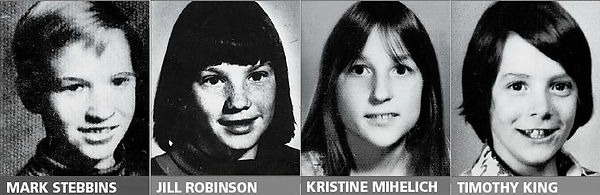
12 year old Mark Stebbins was last seen leaving an American Legion Hall on Sunday afternoon, February 15, 1976. He had told his mother he was going home to watch television. His body was found on February 19, neatly laid out in a snowbank in the parking lot of an office building. He had been strangled and sexually assaulted with an object. Rope marks were seen on his wrists. He was fully clothed in the outfit he was wearing when last seen alive.
12 year old Jill Robinson packed a backpack and ran away from her home on Wednesday, December 22, 1976, following an argument with her mother over dinner preparations. The day after her disappearance, her bicycle was found behind a hobby store. Her body was found on the morning of December 26, along the side of Interstate 75. She was killed by a single shotgun blast to the face. She was fully clothed and still wearing her backpack. The body was placed within sight of the Troy police station, once again laid out neatly in the snow.
10 year old Kristine Mihelich was last seen Sunday, January 2, 1977 at 3:00 pm at a 7-Eleven store, purchasing a magazine. A mail carrier spotted her fully clothed body 19 days later on the side of a rural road. She had been smothered. The body was laid within view of nearby homes, eyes closed and arms folded across the chest, once again neatly laid in the snow.
11 year old Timothy King borrowed 30 cents from his older sister and left his home skateboard in hand, to buy candy at a drugstore on Wednesday, March 16, 1977, at about 8:30 pm. He left the store by the rear entrance, which opened to a parking lot shared with a supermarket, and vanished. In an emotional television appeal, Timothy's father, Barry King, begged the abductor to release his son unharmed. In a letter printed in the Detroit News, Marion King wrote that she hoped Timothy could come home soon so she could serve him his favorite meal, Kentucky Fried Chicken. In the late evening hours of March 22, 1977, two teenagers in a car spotted his body in a shallow ditch. His skateboard was placed next to his body. His clothing had been neatly pressed and washed. He had been suffocated and sexually assaulted with an object. The postmortem showed that Timothy had eaten fried chicken before he was murdered.
They called him the Babysitter Killer which is fucked up and almost sweet to him because of the way he left them and took care of them before he killed them
#1 Suspect

The task force checked out more than 18,000 tips, which resulted in about two dozen arrests on unrelated charges and the busting of a multi-state child pornography ring operating on North Fox Island in Lake Michigan. The case sparked new interest when Timmy King's father, Barry, and brother, Chris, tried to get the Michigan State Police to release information about Chris Busch, the son of Harold Lee Busch, a high level General Motors executive. Chris Busch had been in police custody shortly before Timmy's abduction for suspected involvement in child pornography.
Chris Busch, the son of a high-ranking General Motors executive, was the product of a privileged upbringing which included a stint in a Swiss boarding school.
Chris Busch
At the time of the OCCK crimes Chris was living with his parents in Oakland County’s upscale Bloomfield Township. Chris’s parents were avid travelers, and thus Chris was often left to his own devices in the luxurious Busch homestead. Unfortunately for all, Chris Busch’s devices included a predilection for sexually abusing young boys. Chris first appeared on the OCCK investigators’ radar in 1977 during the interrogation of a pedophile named Gregory Greene, Chris Busch’s close friend and frequent partner in crime. Detectives were interviewing Gregory Greene regarding pedophilic activity at Brother Paul’s Children’s Mission on nearby North Fox Island. Both Gregory and Chris would eventually face charges in the Brother Paul’s Chidren's Mission case. During this interview Gregory Greene reportedly told investigators Chris Busch had confessed to the murder of Mark Stebbins, generally believed to be the Babysitter Killer’s first victim. Chris was charged with crimes against children several times in the late 1970s.

Gregory Green
An Injust Ending

With the passage of nearly four decades hard facts are scarce, but it seems undeniable that Chris Busch’s influential family connections lubricated his dealings with the district attorney’s office as he had improbably good luck with the Michigan justice system despite numerous convictions he was consistently sentenced solely to probation. As Barry King, father of OCCK victim Timothy King told a reporter from Channel Seven Action News, “I don’t understand to this day how you can be found guilty of criminal misconduct against minors four times and not spend a day in jail.
Barry King
On Nov. 20th, 1978 Chris Busch put a .22 caliber rifle between his eyes and pulled the trigger, forever ending his sexual scourge on the innocents of Oakland County. At the time of his death the serial pedophile was 27 years old. His body was found in his bedroom in the Busch family home by a housekeeper. There were several items present at Chris Busch’s suicide scene which may have indicated an involvement in the OCCK crimes: shotgun shells of the same caliber that killed Jill Robinson, bloody ligatures of the type that may have been used to bind the male victims, and a pencil sketch of a boy with a striking resemblance to Mark Stebbins. Chillingly, the boy in the drawing has been captured mid-scream, his face contorted in terror, his hood drawn up as Mark Stebbins’ had been when his body, sexually defiled and scrupulously leaned, was discovered in a snow-covered parking lot two years before. There has been no confirmed activity of the Oakland County Child Killer/Baby Sitter Killer since Chris Busch's death.

Chris Busch Shot Himself in his bed at his families home

Drawing of a screaming boy found on Chris Busch's wall

Rope found on Chris Busch's floor
Oakland County Child Killer Survey
Stuff like this is what makes me so fascinated that it peaks my interest in it. It's probably the writer in me where it's like this is such a good story separate from tragedy or whatever
North Fox Island - Brother Paul's Children's Mission
Due to two floods on two separate occasions in the FBI storage rooms where the files about this story were kept and a whole lot of missing webpages that even the WayBackMachine couldn't find there is very little information or pictures on this. If you have any pictures or articles on this and want to share them please send me a message.

North Fox Island with air strip
The Fox Islands are two small, uninhabited islands off the coast of northern Michigan, about 20 miles west of Charlevoix. North Fox is the smaller island, a desolate 800 acres of woods bisected by a prominent airstrip. In the mid-1970s a child pornography ring was discovered operating on North Fox Island. The proprietor of the island in 1976 was Francis D. Shelden later known as Frank Torey. With the help of several like-minded associates, Francis Shelden decided to start Brother Paul's Children's Mission, a "nature camp" for boys aged 7 to 16, located on his tiny, isolated and uninhabited island.
The organization even obtained tax-exempt status as a charity from the Internal Revenue Service. Francis Shelden was in his late 40s during this time. He was Yale educated, an entrepreneur and heir to a family fortune whose home base was in Ann Arbor. Francis Shelden fancied himself something of a philanthropist. Unfortunately he was also sexually interested in prepubescent boys. Francis used his position in a large social program to fly boys in his private plane to his island retreat under the guise of having a boy's nature camp for them to attend. Brother Paul's was actually a front for an underground child pornography network. Boys were coerced into sexual acts and then photographed for use in porn magazines. Pictures that later turned up in such magazines were determined to have been taken on North Fox Island.
Authorities caught on by the summer of '76, and Brother Paul's chief organizer, Gerald Richards, was arrested on charges of criminal sexual conduct with a minor. Police records indicate Francis Shelden cleaned out his Ann Arbor and North Fox Island residences and left in his private plane shortly after Gerald S. Richards, an associate Francis' in Brother Paul's Childrens Mission, was arrested on criminal sexual conduct charges. That was in July, 1976, approximately one week before state police obtained a search warrant for the Ann Arbor premises. Shortly thereafter Francis Shelden was charged but never extradited after fleeing the country. Francis D Shelden became Frank Torey after fleeing. Frank at first resided at the family-owned mansion on Antigua but eventually settled in The Netherlands, a pornography hotbed, where he lived for two more decades on his family’s extensive wealth.
Prior to Shelden’s death in the mid-nineties, years of attempted extraditions failed. For whatever reason, the Michigan State Police, the FBI, and multiple political characters were unable to extract Frank Shelden from his power and influence, and, in that failure, were unable to extract any justice for the hundreds of boys he’d molested in the United States. There were no doubt hundreds of children overseas who’d also fallen victim to Frank Shelden, heir to the developer of Detroit’s famously extravagant Grosse Point mansions.
State police investigated charges that young boys between the ages of 7 and 16 were drawn to North Fox Island with promises of an 'unspoiled paradise,' only to be lured or coerced into committing homosexual acts. The activity was then photographed by adult directors, according to reports made to the state police, for use in hard-core pornographic magazines. Due to the "Wealth and Respect" of those involved in these most horrifying acts a great deal of this story was "lost." A writer for Traverse City Record-Eagle named Marilyn Wright was one of the only investigative reporters who wrote about this. She wrote a series of in-depth articles about the porno ring trying to show everything that was being swept under the rug.
A Detroit Free Press article dated 12-28-75 describes the generosity of Francis Shelden, a “wealthy Ann Arbor bachelor “ who was on the board of directors of The Cranbrook Institute (a private boys school in suburban Detroit), and Boys Republic, Inc., (a residential center for emotionally disturbed adolescents), who also devoted his time to the Big Brother program. As it turns out Chris Busch, suspected to be Oakland County Child Killer was a Big Brother, too. Greg Greene, who was Chris Busch's partner in crime, was a boys’ baseball coach. According to a subsequent article by Marlyn Wright, Francis Shelden’s buddies Dyer Grossman, who helped him set up the boys nature camp, and Gerald Richards tried unsuccessfully to join Big Brother, but their applications were rejected.


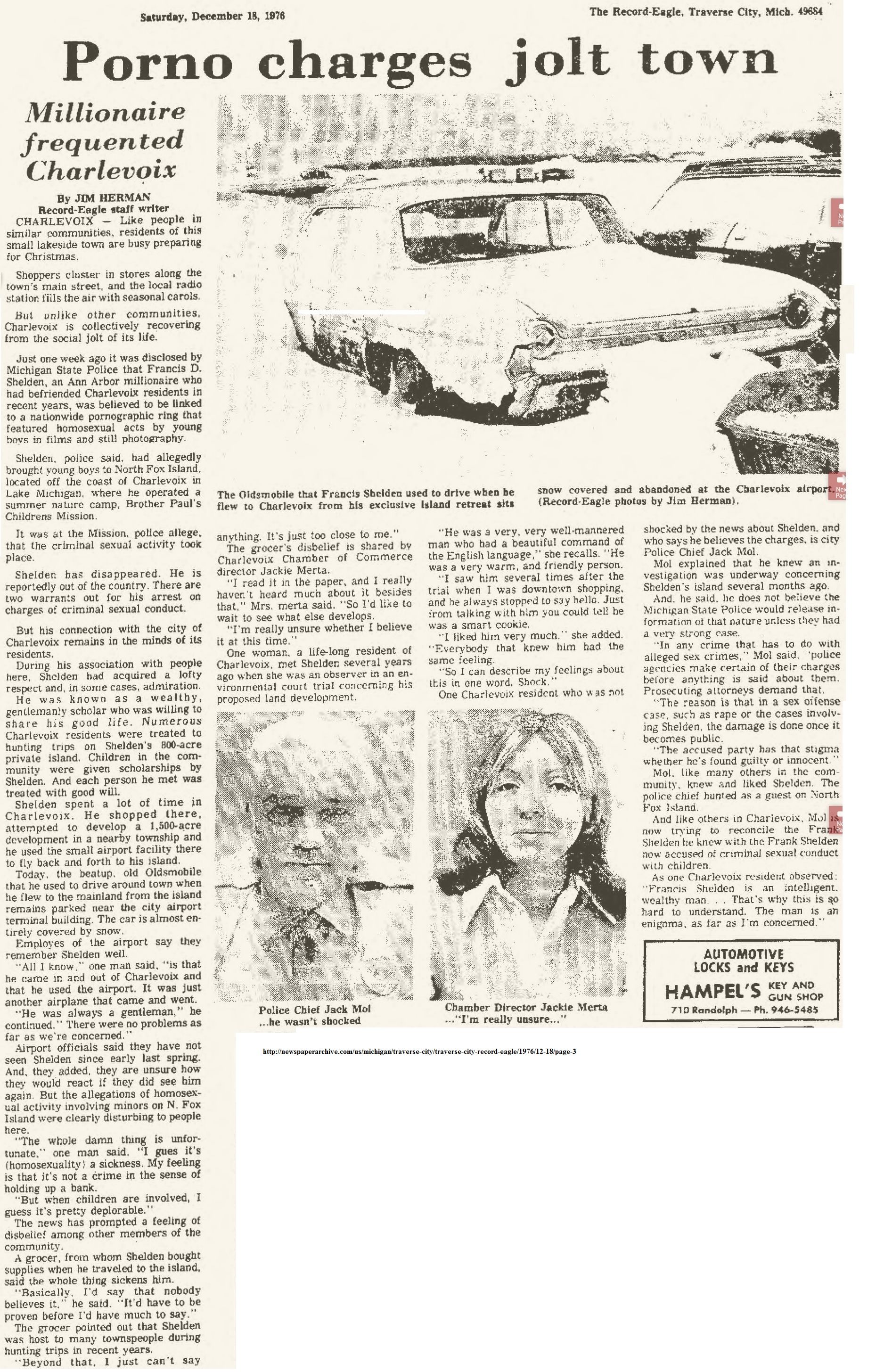
Reports of Frances Shelden’s death surfaced in 1996, and a Michigan warrant for him was cancelled in May, 1997, with state police reporting, “exceptional clearance, suspect is dead and cannot be prosecuted, but was obviously involved.” Private individuals still searching for justice suggest Shelden did not die in 1996, but established a new identity as Frank Torey, and continued to operate in the pedophile world. His close associate, Dyer Grossman, also disappeared and may have assumed a new identity like Francis Shelden (Frank Torey).
The transcript of the U.S. Senate hearings in May and June of 1977, “Protection of Children Against Sexual Exploitation.”
http://archive.org/stream/protectionofchil00unit#page/n1/mode/2up.

Ted Lamborgine
Police in Parma Heights, Ohio arrested Ted Lamborgine, a retired auto worker believed to have been involved in a Detroit child porn ring in the 1970s. He pleaded guilty to 15 sex-related charges involving young boys rather than accept a plea bargain of a minimum 15-year prison sentence and even given a new identity in prison, because it required him to take a polygraph about the Oakland County killings. Ted Lamborgine was also suspected to be the Oakland Child Killer because he would not submit to a polygraph about the OCCK. The evidence indicating Ted might be the OCCK includes statements made in a separate child molestation case against him, where a boy claims he was sexually molested and nearly suffocated to death in Royal Oak clearly showing that there were similarities between his M.O. and the OCCK's M.O.
Ted Lamborgine pleaded guilty to 15 similar molestation charges for abusing children in the Cass Corridor in the 70's and 80's and has been sentenced to life in prison. Police said he would lure boys in with food, soda and drugs for the purpose of sexually assaulting them. Ted Lamborgine and his buddies including Bob Moore and Richard Lawson preyed on poor kids from the Cass Corridor, a particularly run-down section of the city, but Ted liked to cross 8 Mile Road into the tonier areas to troll for kids and mix with suburban pedophiles. One of his victims described being held captive, assaulted, and then fed.
Richard Lawson, who was Ted's partner in the Detroit pedophile ring, informed on him in hopes of receiving a lighter sentence when he was finally arrested for his own crimes. Richard Lawson killed his boss in 1989 and then fled Michigan and settled in California for the next fifteen years. Detective Williams solved the cold case in 2005 and flew to California to arrest Richard. While searching through his past criminal records, Detective Williams read a comment Richard Lawson had made to police when he was pulled in on a robbery charge in Pennsylvania in 1989. The comment meant nothing to the local Pennsylvania police, but Lawson’s declaration 14 that he knew who was responsible for the “Snow Murders in Oakland County” meant a lot more for Williams. “Snow Murders” is a street name for the OCCK murders; all four children’s bodies were dumped in various locations outdoors in Oakland County after a heavy snow fell.
The name Richard Lawson grudgingly provided to Detective Williams in hopes of a lighter sentence was that of Theodore “Ted” Lamborgine.
Richard Lawson claimed he was only a part of the pedophile ring so he could inform on the actual pedophiles. He also claimed that he only molested kids to prove to the other pedophiles that he could be trusted. This defensive strategy used during his trial failed as no one believed this was at all true. Richard Lawson was convicted of five counts of criminal sexual conduct with persons under the age of thirteen and convicted of one count of homicide and was sentenced to life in prison. Bob Moore died in 1996 in his apartment and his pit bulls had devoured his body before it was found.

Bob Moore
To me pedophiles and kiddy porn that kind of shit is the darkest, Like serial killers who just kill random people, obviously not good, but that kind of stuff? What is wrong with that person? They're not just doing the wrong thing but they're loving doing the wrong thing. Exploitation is the darkest thing to me, it is the closest thing to real monsters to me.

Season 2 was set in Luverne, Minnesota during the winter of 1979. It focused on 33 year-old Lou Solverson as a state cop recently back from his service in the Vietnam War. His daughter, Molly, is six years old and his wife's fate is ultimately revealed. The story depicts the violent Sioux Falls incident that Lou often spoke of in Season 1. As season 2 progresses it follows the lives of a young couple — Peggy and Ed Blumquist —as they attempt to cover up a hit and run and murder of the son of a crime family. During this time, Minnesota state trooper Lou Solverson, and Rock County sheriff Hank Larsson, investigate three murders linked to Rye. The second season was used to expand the scope of the show's storytelling — from its narrative to its characters.
Told by Tom Sibley from the Feral Audio podcast We Watch Wrestling.
Oh hey this is Tom Sibley! My murder story is where my parents live. I'm not going to say where they live. It's an island in New Jersey. There was a guy that everyone used for their upholster. He made really good couch cushions especially for outdoor furniture like outdoor cushions. Everyone has his stuff and he killed his mother because he lived with his mother. He killed her and he kept her. Like in the house four months. No one knew where his mother was and etc etc. Later on it came out that he killed her and was just kind of keeping her body in the house. How did he kill her? I'm not sure I think it may have been strangulation. It's just weird because everyone has the cushions of this guy, he was the go to guy for cushions and like I was just sitting on those cushions a week ago. It was the cushions of a mother murderer. So everyone just kept the cushions and was just like well?!? They're good cushions.
Angelo Anthony Buono Jr. was an American
serial killer, kidnapper and rapist. Angelo and his cousin Kenneth Bianchi together are known as the Hillside Stranglers. Kenneth Bianchi and Angelo Buono would cruise around Los Angeles in Angelo's car and using fake badges, persuaded women they were undercover police officers. The women and girls ages ranged from 12 to 28, and from various walks of life. They would then order the victims into Buono's car, which they claimed was an unmarked police car, and drive to Angelo's home and upholstery shop to rape torture and murder them.

Officers from the Glendale Police Department stand guard in front of the house and upholstery shop of hillside strangler Angelo Buono
Angelo Buono, Jr.'s home was in Glendale, Calif., from which he ran an upholstery business out of his garage. Angelo was a street-tough sub-normal creature always trying to prove his manhood and authority. He reveled in being Italian and flew the Italian flag 24 hours a day from a flagpole on the grounds of his house. Angelo considered himself to be an "Italian-Stallion." He was already parading prostitutes through his home by the time his cousin, Kenneth Bianchi, arrived to stay in his home in 1975. One night, as the cousins sat about getting drunk on beer, they speculated as to what it might be like to actually kill someone.They started their mass murder spree in 1977.


Glendale upholsterer Angelo Buono was convicted of 9 of the Hillside Strangler murders after the jury condemned him to life in prison without parole.
For more than two years, Buono and his cousin Kenneth Bianchi roamed the streets of northeast Los Angeles and Glendale, sometimes flashing fake badges to lure their victims. They were all killed in Buono's Glendale automobile upholstery shop. In 1983, both men were found guilty of the murders they had committed and, in spite of the cruelty of their crimes, spared the death penalty and sentenced to life in prison. Angelo Buono died of natural causes while serving his sentence in 2002 at the Calipatria State Prison in California. Kenneth Bianchi is still serving his sentence at the Washington State Penitentiary in Walla Walla, Washington.
Kenneth Bianchi
I don't know, just like try to be nice to people...be excited for yourself that you aren't murdered yet and enjoy yourself, do what you want. Don't do what someone is telling you that you haft to do because there is no haft to because you never know what could happen.

Sooz Curtis
Bianka Meily
Leslie P.
Stacey Kirkby
Terri Burke
Thanks To These Very Helpful Individuals This Episode Came Together In A Way That Lets All Murderinos Enjoy The My Favorite Murder Podcast Even More Than They Already Did!
We Commend And Applaud Your Hard Work!
Thank You!!!!
Leave a comment and let me know if I missed anything, if you have anything to add, or give your thoughts on this episode :)
